Flight of imagination


Cinema Telugu film director S.S. Rajamouli talks about his Makkhi taking a successful flight to Bollywood. ANUJ KUMAR
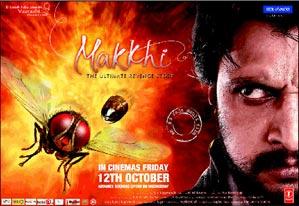
“Now I can tell the world that the Indian film industry has Salman Khan on one side and aMakkhi on the other.” This is what Shekhar Kapur told director S.S. Rajamouli after watching the antics of his precocious fly. After a long time a dubbed film has created buzz at the Bollywood box office, and Rajamouli is elated.
Son of eminent Telugu writer and director S. Vijeyndra Prasad, Rajamouli says the idea ofEega (the title in Telugu) came from his father in the early ‘90s. “He narrated to us this love story where the villain kills the boy and he gets reincarnated as a housefly and torments the bad guy. We found it very funny.” Years later, after making a series of big-budget action blockbusters, when Rajamouli decided to “dabble in something small” the funny story came back to his mind. “Small films are usually romantic films, comedy films or horror films – the three genres I am not comfortable with. I wanted to make an experimental film which would shock the audience in a positive way. At that time the story resurfaced in my mind.”
Rajamouli says that when he started the idea was to make a Rs. three-crore film in five months. “Initially I was hesitant because, come to think of it, the idea was crazy. I thought only a small section of the audience would dare to come to theatres. But when the story was complete we knew we had a winner on our hands. So we went all out. It ended up being a Rs. 30-crore film and was made in two years.” According to reports the film garnered around Rs.130 crore in the Telugu, Tamil and Malayalam versions.
The film’s special effects have been appreciated. Rajamouli maintains that the perception that special effects will take a whole lot of budget is a misconception. “There are ways of working around it. I went for relative newcomers and gave them training. This film would have cost me four to five times more if I had gone to any established studio. I like larger-than-life ideas. I take an impossible situation and then make the audience believe in it. Sudeep is a superstar in Karnataka but I approached him after seeing his performance in Rann . I was not sure whether he would accept a negative role but not only did he accept the role but also made it so nuanced and intense.”
What prevents him from turning his works into Hindi, considering directors like A.R. Murugadoss and Siddiqui have done it? “As a storyteller I want to reach out to as many people as possible but I don’t want to make a remake. I spend almost two years on one subject, and I don’t want to spend another two years on the same subject. However, in my forthcoming films I am looking at the possibility of shooting my films simultaneously in Hindi.”
Rajamouli is all for the change that Hindi cinema has seen in the past couple of years. “The Hindi film industry is offering a complete package. On one hand there is mass masala like Rowdy Rathore and Salman Khan films, and on the other hand you have experimental films like A Wednesday , and there is space for innovative ideas like Vicky Donor as well. These films are commercially successful and catering to different sections of the audience. That is the way an industry should be.” Does the socio-economic profile of the audience coming to theatres influence the kind of films that are being made? “It could be just an argument. It is a chicken-and-egg kind of situation. You can’t deny the fact that there is too much gore in our films and I am myself guilty of it. In the last two to three films I have completely cut down the sleazy part and edited out too much violent portions but, being a director who has gone through this route, I feel we go for these things more out of insecurity rather than the audience wanting it. We feel that youngsters might like it. It is more out of insecurity than anything else, but I gradually realised that we are losing more audiences rather than gaining them. It is just a matter of time when we will be catering to all sections of society,” signs off Rajamouli with the promise that he is working on a big-budget historical.
I take an impossible situation
and then make the audience believe in it.


BLOOD DONARS LIST

Post Your Name,Blood Group,Place,Contact Number 
in Below Comment Box.....
Wil Update that Information in this Post


Hyderabad

1.Phaneendhra Varma, B+, Ph 9505745666
2.Anjan Babu, A+, Ph:9908121099
3.Prudhvi, O+, Ph:9550919962
4.Suresh O+ ,Ph 8143090909
5.K. Shiva Krishna O+ , 9848346499
6.Haribabu Amudalapalli,B+ve,7396807475


  • Bangalore 

    1.Syam Kumar, O+, Ph 8553156729
    2.Shivshankar , O+, ph 09632339243
    3.Raveendra Reddy. , B +ve , +91 8884100962
    4.Siva venkateswara rao Bolla ,  O +  ,9440782007/9686456457

    Chennai 

    1,Ravindra ,  O +ve , +918939176708
    2,RAGHU SRAVAN KUMAR ,B+ ,9600150924

    Trivendram

    1.Suresh Reddy, 'O+ve',7736238768

    Kurnool
    1.Ranga reddy, A+,9052888877

     vijayawada
    1,sriram, o+ve , ,7799456232


  • Bumper amount for Eega Hindi satellite rights


    Makkhi satellite rights sold for Rs.8 crores


    SS Rajamouli's Eega, which flew high in Tollywood, migrated to Bollywood as Makkhi. Unfortunately, Makkhi failed to reach the heights in Bollywood. However, it was not a failure too. Anyway, success came in another form as the satellite rights of Makkhi were sold at eight crore rupees, which is undoubtedly a big figure for dubbing movies. Telugu film makers who have plans to dub their films in to Hindi can now be happy since Telugu dubbed movies will apparently be purchased for big amounts even if the movie doesn't do well at the box office. Rajamouli seems to be happy that his film's satellite rights were purchased for such a huge amount.


    Makkhi: Sensational superfly


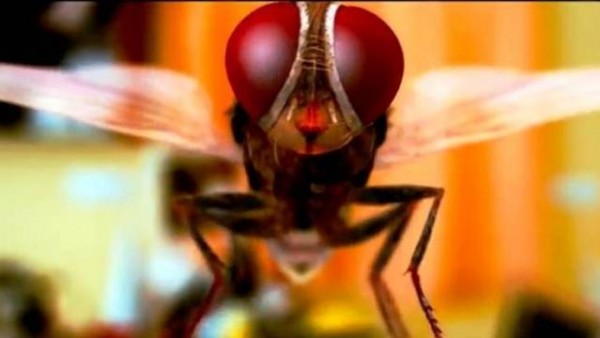
    With bulging red eyes, tiny winged structure and wiry hands that victoriously punch the air, the fly in SS Rajamouli’s Telugu film, Eegathat now releases in Hindi as Makkhi has become a rage among the masses. And Makuta VFX, the studio that has worked on films like V. V. Vinayak’s Badrinath, Rajamouli’s Magadheera and Maryada Ramana, is responsible for bringing this fly to life. This revenge story of a man reborn as a fly to avenge his death and protect his girlfriend has over 2000 shots of computer graphics and was one of the toughest projects that the studio has worked on, according to Pete Draper, co-founder, division head and chief technical director at the studio. “Originally the film was going to be relatively low-budget and it would take shorter time in post-production but as the script progressed, the amount of animation treatment in the film increased and became more complex. The budget of the film also went up to Rs.25-30 crore,” says Draper. Here’s a look at how the studio achieved the animation of Makkhi.
    Bringing fly to life
    According to Draper, the studio took the references for the fly’s anatomy from real life flies. “We froze a lot of flies, so they go into hibernation but it doesn’t kill them. We photographed them closely to understand their anatomy, structure, etc,” says Draper. After creating the initial rig of the fly, the team began to shoot the film with this design but it didn’t work. “The body animation and the wings were fine but the face looked hyper-real and the design aesthetics didn’t work,” reveals Draper and adds, “We needed to exaggerate the physical features. For instance, we integrated a little nose, added feelers, toned down the hair and made it a little more fluffy like a mane on the fly’s head. It took nine months to lock the design of the fly.”
    Integrating live action with animation
    As the fly had to be integrated into live action scenario, it was imperative for the animators to be present on the sets during the film’s shoot to get clarity on the fly’s body movements. “The director treated fly as another character and he directed it as he would direct other actors. So two animators would shadow the director and they would do walk-in animation for the shots. For instance, as soon as the shot was taken, it would be trimmed, the animators would block the animation and show it to the director. After that, the director would dictate how the fly would move, it’s expressions, etc. We also recorded his instructions that aided the animators while working in the studio.”
    Software used for animation
    The studio created a split pipeline where Autodesk 3ds Max was used for modelling and animation while Autodesk Maya, with its innovative tools, was used for character animation. “The animation process took around eight months with around 20 artists—in house and outsourced— working on the animation. We used a split pipeline and the rendering of hard surface animation was done using 3ds Max.”
    Facing challenges
    Many sequences in this film proved to be quite a challenge for the studio. Moreover, some of the sequences that the studio worked on for months didn’t even make it to the final edit. “There is a scene where the fly gets stuck in the chain of a bicycle and we spent three months of production to create a perfect bicycle using VFX but the scene didn’t make it to the final edit,” says Draper. Another sequence that proved to be challenging was a scene in the film where the fly is just born and it has to leave the trench. “We had to make the trench look like Grand Canyon in front of the fly. He is running along the wall as its wings are not fully developed and simultaneously, water droplets fall on him, he is thrown from one wall to the other. This was the most complex scene because it involved every single discipline,” says Draper. For this particular scene, the animation artists used painting work, fluid dynamics, high levels of geometry, dynamic effects, etc. “For an average sequence involving visual effects, you roughly work with about maximum 10 million polygons to create images. For this scene, it took five billion polygons due to the amount of detail in terms of trench walls, debris, foam, etc. That was absolutely astronomical!” exclaims Draper.
    Changes in the Hindi version
    Surprisingly, the studio’s work didn’t end with the release of the Telugu version. Post the Telugu and Tamil release, the animators made a couple of changes in the film to tailor it for the Hindi market. “We jazzed up the effects in certain scenes that we were unhappy with. Moreover, in the Telugu version, we have an Eega dance number where he does specific dance moves related to South stars. In the Hindi version, we have shown him pay homage to Bollywood stars. For instance, he is doing the famous Salman Khan dance move with a towel.”
    courtsy : indianexpress


    Exclusive: Eega DVD/ Blue-ray Released

    'Makkhi' to get Japanese makeover: SS Rajamouli


    After getting rave reviews in Telugu, Tamil and Hindi, director SS Rajamouli's realistic animation 'Makkhi' is all set to be dubbed into Japanese and Swahili.
    Rajamouli, 39, whose 'Vikramarkudu' and 'Maryadam' have been remade in Bollywood as 'Rowdy Rathore' and 'Son of Sardar', debuted in the Hindi with the quirky film that revolves around the revenge of a fly.
    "We shot the film in Telugu and Tamil and dubbed the film into Malyalam. We converted it into Hindi as well and it is a huge success everywhere. Now, we are in the process of dubbing it into Japanese and Swahili. But the process is in its initial stage as we have only spoken to a Japanese authority to dub and distribute the film there," said Rajamouli.
    The film has been appreciated by the Bollywood A-listers and Rajamouli said he expected positive review right from its inception.
    "We make a film because we think it is good and people will respond positively but we don't know to what extent. So it feels great when big directors and big stars praise your film," he said.
    Rajamouli, who generally makes action films, says 'Makkhi' was inspired by a story that his father narrated to him long back.
    "My father is a scriptwriter. He has done many films down south. He has written for most of my films. It was in early 90s and then I was not even assistant director. My dad used to narrate my cousins a new story after every two days. That time he narrated me the story of Makkhi. We found it very funny and interesting, which I revived when I turned director."
    But the director said he had almost scrapped the idea of making the film because he was not happy with the animated fly.
    "Initially I wasn't sure about the film because a lot of visual effects were involved in it. Last year when I was checking the first shot of our hero (animated fly), I thought to scrap the project because it was not upto the mark. Nothing was right about it but we had already spent 10 crore by them. We had to start all over again with the animation." Asked about why he chose fly as the protagonist of the film, Rajamouli said, "Fly is something which we look at as harmless. We look at it as if it does nothing to us so, the dramatic sense increases. That's is why we retained the fly." The director roped in superstar Ajay Devgn to give the voice-over of the fly in the Hindi version.
    Courtesy : indianexpress.com

    I was going to scrap the Makkhi: SS Rajamouli


    A still from the Telugu movie Eega.
    He thought of making it as a minimal budget movie with an expenditure of not exceeding Rs. 3 crore, made it for over Rs.30 crore and it has already grossed over Rs. 130 cr so far in Tamil, Telugu and Malayalam. But did you know that director SS Rajamouli (inset) was going to put the project in a bin?

    “I had never done animation and after about seven months of production, when I saw the initial work, I was so disappointed and frustrated that I was going to scrap the film. But then I realised that we had already spent Rs. 10 crore on it so far, so I couldn’t have put so much money to waste,” Rajamouli, 39, told us while he was in the Capital to promote the Hindi version of the film.

    With opening narration from actors Ajay Devgn and Kajol, it hit the screens on Friday. Rajamouli got the idea for the movie from his story-writer father over 12 years ago and it took him two years to bring the project to the big screen. The director doesn’t deny chances of having a sequel to the fly revenge story if he manages to come out with “a great story” but is confident that if a Part 2 comes out, “it will definitely be in 3D”.

    Not many know that Rajamouli’s hits Vikramarkudu and Maryada Ramanna have already been remade in Bollywood as Rowdy Rathore and Son of Sardaar (SOS) respectively. The rights to his 2009 period-drama Magadheera have also been bought by Anurag Kashyap. “I’ve only seen Rowdy Rathore so far and I liked it,” he said while praising SOS lead actor Devgn as “the most dependable actor in Bollywood”.

    courtesy : hindustantimes.com

    SS Rajamouli Times Of India Interview - Interesting One


    Is it true after Makkhi you've finally decided to take the plunge into making a Hindi film? Yes, it's actually going to be a Hindi-Telugu film. It's a universal story, not star-centric film. When I was in Mumbai for the promotion of Makkhi, I met Ajay Devgn, Kajol and Shah Rukh Khan and I wanted to meetAamir Khan. He was shooting out of India. I also met my favourite director Raju Hirani. All of them showered praises on Makkhi. I am now confident about attempting a Hindi film. I believe if you have a good story to tell, audiences will watch it. 

    Whom would you be working with in Hindi? It would have to be the Telugu star Prabhas.We are committed to make the next film with him. I did work with Ajay Devgn and Kajol who did the voiceover in Makkhi. I wanted a couple with easily identifiable voices but with an image for being family-oriented. Ajay and Kajol fitted the bill. You get a good feel about them. Ajay agreed when I approached him. But I insisted he see the film first. After seeing the film the first thing he said, 'I must show this film to my kids.' 

    I believe you've zeroed in on the subject that you want to do in Hindi? Yes, I am looking at shooting my next film in Hindi and Telugu. It is a period film but not historical. It's a folk story. And no, it's not about reincarnation. I'm done with reincarnation after Magadheeraand Eega

    What's this fascination with the theme of reincarnation? It started with Rakesh Roshan's Karan Arjun.I remember watching that film. For the first time, I openly laughed and wept during a film. Earlier I was very reserved about my emotions. Karan Arjun opened up my emotions. 

    Why have you stayed away from Hindi cinema so far? To be very frank I never got very good offers from Hindi cinema until Eega. Now I'm flooded with offers. But I've some commitments to fulfill in the south before I head to Mumbai to make a film. Of course as a storyteller I want my cinema to reach a larger audience, no doubt about that. 

    Your films have been remade and dubbed into several Indian languages. Yet you continue to function from Andhra Pradesh? I am very happy and proud to be known as a Telugu filmmaker. I am glad to know my films make a pan-India impact. I see no linguistic impediment. But to make a film in Hindi would be an advantage. It has to be a universal story like Makkhi. A fly is a fly anywhere. Vikramarkurdu was made as a star-vehicle for Ravi Tejaa. I couldn't have made it for the entire country. It was tailored for Telugu audiences. 

    Why didn't you direct Rowdy Rathore, the Hindi version of your hitVikramarkurdu? Because it was never offered to me! And even it was, I wouldn't have done it. I'll be making an original film in Hindi. No point in doing the same film twice over. 

    What did you think of Rowdy Rathore? Frankly, I'm not a fan of my original film in Telugu either. I know it had some good moments, for example the sentiments shared between the hero and the little girl who reforms him, which made the film work. The re-makers exploited those moments but not enough. We gave much more footage in Vikramarkurdu to the father-daughter scenes. 

    The refrain Chin ta ta chi ta ta in Rowdy Rathore was lifted from Vikramarkurduand used into Rowdy Rathore. Actually, it was not our original tune either. My music composer M M Kreem didn't compose it. It's like ...how do I put it? A folk tune in Tamil Nadu. It's a kind of anthem refrain among students in the State. Youngsters compose their own crude protest songs and then cap it with Chinta ta ta. It has existed in Tamil Nadu for generations. I made it a part of Ravi Tejaa's character and then it was given to Akshay Kumar. 

    Do you approve of filmmakers lifting secondary material? I think there's a very thin line between copying and adapting. I think its okay to use material from earlier films. As long as it doesn't hurt the original creator we can use it. 

    Can you give me an example? In so many films of mine I've used scenes and shots inspired by earlier films. My Maryada Ramanna (now remade into Son Of Sardar) was inspired by a 1923 Buster Keaton silent film Our Hospitality. One could say I copied the film. I don't mind. When I saw the original I liked it so much I wanted to re-tell the same story on my own way. I even tried to find the original creators. But no one existed. The original writers died in the 1930s. Technically any material that has existed for more than 75 years can be used without a copyright claim. But if you use material in Hindi film from a contemporary Punjabi, Oriya or Telugu film you need to take permission. 

    What did you think of Akshay Kumar in Rowdy Rathore? When I made my film I made Ravi Tejaa pander to Telugu sensibilities. I think Prabhu Deva who directed the Hindi remake, made Akshay Kumar act according to the tastes of North Indian sensibilities. The two performances cannot be compared. 

    Now your Maryada Ramanna turns your Telugu hero into a Sardarji in Son Of Sardar? I don't know what the cultural politics of Punjab is like. But in one area of Andhra Pradesh family feuds that persist for many generations is a reality. That's what I showed inMaryada Ramanna. I saw families that were perfectly cultured and courteous, killing each other. Now you will have to tell me if such family feuds exist in Punjab. I don't think this peculiar contradictory culture of the co-existence of violence and hospitality exists in Punjab. 

    Even your other blockbuster Magadheera is being remade into Hindi? Why don't you direct it? No thanks. I've already spent two years of my life on it. I'd rather make something else. Magadheera was my toughest film to make. Very tiring. But the most satisfying film I've made is Maryada Ramanna. That's my only film I don't get bored watching in its entirety. But Eega (Makkhi) is my biggest hit to date. 

    How did you think of making a film with a fly as a hero? It was there in my subconscious for a long time. My father was a well-known storywriter. He was a storehouse of stories. He told me a story about a boy who was killed by the villain and was re-born as a fly. I wanted Eega to be like a bedtime story. 

    The special effects in Eega-Makkhi are being compared with Hollywood films? I'd like to thank one Mr. Kamal Kannan, a VFX producer who has worked with me in several films. I was confident about the visual effects because I had done them before. But animation was entirely new to me. All the animation technicians in my film were youngsters in the 25-28 age groups. Looking at them you can't tell they are such high-calibre professionals. What I am proudest of in Eega is the animation. 

    How did the fly in Eega acquire its human personality? We had to make sure that the fly behaved the same way as the actor Naani who dies and is born as a fly. The quality in Naani's personality that had to be transferred to the fly was positivity.Once we got that in place we had to work on the physical appearance of a fly. In close-ups an actual fly is ugly. At the same time if we changed it, it would become a cartoon character. I have to thank the actor Sudeep who plays the fly's adversary for making the conflict look believable. I can say without any reservation that Sudeep is the best actor I've worked with. Shekhar told me the visual effects worked so effectively because of Sudeep. The fly has no expressions. It is only through Sudeep's expressions that we know what the fly is up to. 

    Why and how the fly was designed wearing a mask? When we sat down to write the script the first question was, why is it so difficult to kill the fly? That's when we thought the fly should have a protective mechanism. And to make that protective mechanism for the fly we made the heroine a miniature artiste. 

    Has Ajay Devgn shows you the remake of Maryada Ramanna? Not yet. 

    What did your children think of Eega/Makkhi? They loved it. My son and daughter constantly talk about films. I am getting worried. I feel I am pushing them prematurely into cinema.

    Filmfare Movie Review: Makkhi


    Cast: Sudeep, Samantha Ruth Prabhu and Nani 
    Director: SS Rajamouli 


    Picture this: A fly sporting hi-tech goggles and washboard abs enters a speeding car through the vent and distracts the villain who is behind the wheel, only leading to an accident. This fly can dance like Hrithik Roshan in Ek Pal Ka Jeena and can also do the chinta ta chita like Rowdy Rathore. Most importantly, it can protect the girl of his dreams from the bad guys. Yes, it’s a superhero fly. Move over Superman. 


    Makkhi is a dubbed version of Director SS Rajamouli’s hugely successful Eega down South. Riding on a novel concept and exemplary execution, this revenge film has its own special sting. 


    A good-for-nothing bloke Jaani (Nani) falls for the pretty Bindu (Samantha Ruth). The feelings are mutual but the girl shies away from expressing her love towards him. Enter Sudeep (Sudeep), the vicious party pooper, who also falls in love with her. On learning about her affection towards Jaani, all hell breaks loose. He murders the lover boy. Wait, it doesn’t end there. Jaani is reborn, as a housefly. Yes, a housefly. And this Makkhi doesn’t fancy breeding along garbage cans with its brotherhood, instead its sole motive is revenge. 


    The wafer-thin plot of this film doesn’t affect its novelty. The zany concept does the trick. Brilliant camera work and intelligent use of CGI ensure a visual spectacle. It’s almost like riding on the back of Makkhi. It takes you from every imaginable nook and corner of a household setup. Sometimes, the camera movements actually make you feel dizzy. 


    'Makkhi hoon main makkhi, sair kar narak ki. Meri ek nazar se tune maut chakhhi.’ This is Makkhi’s signature tune. And each time the fly takes its stance, the thumping background score makes you want to clap and hoot. 


    Funny thing about Revenge, it could make a killer out of a housefly. Jaani as the fly shocks the living daylights out of Sudeep. Some spectacular scenes infused with humour are this films highlight. Take for instance the scene where Sudeep sprays HIT (a fly repellent) all over Jaani only to realise the fly is well-guarded to rinse the chemical off its body. This scene in slow-mo and later Sudeep’s expression is something you’d never be able to forget. The film also pays homage to Rajnikanth by using one of his famous dialogues from the film Sivaji as an introduction to the fly. 


    Kudos to Kotagiri Venkateshwar Rao for coming up with such a novel concept and director Rajamouli for his commendable execution. Despite the umpteen absurdities, Makkhi comes across as utterly ridiculous, yet believable. It’s a silly joyride with bouts of shameless fun. Go for it!

    Review: Makkhi is a technical stunner


    Ankur Pathak feels Makkhi is a visual delight.

    Makkhi, which was released in the original Telugu version as Eega in July this year, is a meticulously crafted live-action film brimming with conceptual originality.

    It boasts of delightful CGI-integrated action with the theme of vengeance.

    The Hindi dubbing is superficial and substandard but that doesn't matter much.

    The film has a wafer-thin plot, which in a way is good as it actually eliminates the need to process the dialogues in the first place. This is because Makkhi is visually explanatory, and stunningly so.

    The intricacies of detail are remarkable. Like when the super-fly is attacked by a lethal spray, one can actually spot the chemical rinse off its body.

    The super-fly at the heart of all the action is a Hindi film songs-loving reincarnation of Jani, a young fireworks maker who is brutally murdered by a womanising industrialist.

    Jani's romance with the NGO-running Bindhu was about to take off after a two-year struggle, but is fatally interrupted by the villainous Sudeep.

    Reborn as the fly, Jani seeks revenge as he had sworn to do just before his death.

    'Makkhi hoon main makkhi, sair kar narak ki. Meri ek nazar se tune maut chakhhi,' he warns.

    Makkhi stays true to his words as he annoys the buzzing daylights out of Sudeep by shadowing him like a dreaded psychopathic stalker who won't relent unless his revenge is complete. We root for the fly as he employs one smart tactic after another, making Sudeep's life resemble a post-apocalyptic nightmare.

    The camera work is beyond belief. The makers have used Scorpio cams to capture complex shots. The result is a mind-blowing rampage of uniquely filmed scenes. 


    But it's not just all about a fly destroying infrastructure. Themes of jealousy and vengeance, of losing out due to indecisiveness, of survival and bad karma hitting back in the most confounding forms are deftly interwoven.

    At its heart, Makkhi  is a love story that never got the life it deserved. Jani remains a friendly stalker to Bindu  in his lifetime and is reunited with her as the fly -- again a constant companion, a watchful protector.

    At the centre of the commotion is the target, Sudeep, who gives a frighteningly realistic performance of a man haunted by an inexplicable force. His expressions and body language are spot on, and one shudders at the reign of terror unleashed against him.

    The length of the film plays spoilsport. Makkhi could have been a far more engaging product had it eliminated the last 20 minutes which just stretch out the film. A suitable closure could have been achieved earlier.

    But overall, this super-fly is a super-stud, a bee-sized package that promises definite entertainment which even the so called larger-than-life superstars fail to achieve or achieve at a highly superficial level.

    Director S S Rajamouli and Kotagiri Venkateshwar Rao, who handled the editing and camera work, and the entire team deserves thundering applause.

    Rediff Rating:
    Ankur Pathak in Mumbai

    India's No1 Critic Rajeev Masand Makkhi Review


    Fly high!


    Makkhi

    Rating: 4
    October 12, 2012
    Cast: Sudeep, Naani, Samantha Ruth Prabhu, Voices of Ajay Devgan & Kajol
    Director: S S Rajamouli
    In Makkhi, the Hindi dubbed version of the blockbuster Telugu film Eega, a man is reborn as a housefly so he can avenge his own death. Few films are as wildly imaginative and as consistently entertaining as this one from director SS Rajamouli, who takes popular reincarnation sagas like Karan Arjun and Karz, and turns them on their heads.
    Makkhi begins as inventively as the rest of the film unfolds – with a blank screen accompanied by the voiceover of a father (Ajay Devgan) narrating a bedtime story to his daughter. “Once upon a time, there was a fly,” he begins, kicking off the story of our protagonist Jaani (Naani) a man ardently in love with his colleague Bindu (Samantha Ruth Prabhu). Yet it all goes horribly wrong when a lustful business tycoon Sudeep sets his eyes on Bindu. When Jaani is murdered, his soul comes reincarnated in a fly to take revenge on Sudeep, and to protect his love.
    With large opaque eyes, Jaani the housefly doesn’t have the facial expressions that you would see in animated films like A Bug’s Life, but Rajamouli invests so much personality in the insect by making use of his little body and spindly limbs.Makkhi has a superhero, comic book quality; you watch half-incredulously, half-amused as this persistent fly drives Sudeep insane. The fly becomes a character you root for, and incredibly, you can see characteristics of Jaani the human in the tiny bug. The animation in Makkhi is unfussy, but this is a great example of how the idea is truly the star.
    Kannada actor Sudeep plays his part of the cold-hearted villain with true comic book flair and even a cartoonish tinge. It is because he is a powerful antagonist that you relish the face-off between the fly and him. Even if the film gets a tad repetitive towards the climax, it ends up a unique cinematic experience.
    I’m going with four out of five for SS Rajamouli’s Makkhi. Make sure you don’t miss it; it’s the most fun you’ll have had at the cinema in a long time!
    (This review first aired on CNN-IBN)

    Wanted audience to connect with fly: 'Makkhi' designer


    Establishing an emotional connect between the fly and the audience was the biggest challenge for Pete Draper, the brain behind creating the housefly character in Telugu film Eega, releasing in Hindi as Makkhi Friday. 

    Co-founder of US-based Makuta VFX, Draper, who hails from London, worked with as many as 13 experts and a huge team of animators to create the adorable fly for Eega that created history at the box office by garnering a whopping Rs.17 crore on its first day. 

    "Our biggest challenge was to make the audience emotionally connect with the character. Since there was little facial features for us to play with to display emotion, we took reference from silent movies," Draper told IANS. 

    "We wanted the design of the fly to be unique. He shouldn't be ugly. Viewing a normal fly 40 feet in size on a big screen will make the audience lose their popcorn and have kids screaming for the exit, so even though the body was based on a real fly, the head was toned down," he added. 

    Eega, a revenge story, rocked the box office and set the cash registers ringing. Now, Makkhi will narrate the story of a man who is killed and is reincarnated as a housefly to avenge his death. 

    How long did the project take and how many designers were involved? 

    "The fly was designed by three concept artists, three modellers, two shader designers, two hair and fur designers, three riggers and numerous animators. Due to different versions, it took almost eight-nine months to finalise the design," said Draper who has a bachelor's degeree in IT. 

    "The initial body and wing shape got locked first and this was followed by the head and fur. We were refining the design daily and even worked on clay models on the set to finish the design as soon as possible", he added. 

    Directed by S.S. Rajamouli, the innovative and technically Eega was made on a budget of Rs.30 crore. 

    Draper, who teaches VFX and animation in various colleges in London and has an office in Hyderabad too, was slightly apprehensive when Eega released July 6. 

    "Yes, I was apprehensive. The response from the trailer and audio launch had been positive so the apprehension was reduced; however, there is always a nerve-racking time during the first couple of days. 

    "We knew we have created a good work but were unsure if the audience was ready for it; it turned out it was," he said.

    Courtesy : TOI

    Makkhi Review by Taran Adarsh


    Makkhi
    By  Taran Adarsh, 9 Oct 2012, 15:02 hrs IST
    4

    Roman Polanski, the acclaimed storyteller, once remarked: 'Cinema should make you forget you are sitting in a theatre.' S.S. Rajamouli's MAKKHI, the dubbed Hindi version of the Telugu blockbuster hit EEGA, does exactly that. Original, inventive, innovative and imaginative, MAKKHI raises the bar of films made in India.


    Right from Bimal Roy's MADHUMATI and L.V. Prasad's MILAN to Subhash Ghai's KARZ, Chetan Anand's KUDRAT, Shakti Samanta's MEHBOOBA, Rakesh Roshan's KARAN-ARJUN, Sanjay Gupta's HAMESHAA and Farah Khan's OM SHANTI OM, reincarnation tales were all about the lead man getting reborn in human form. In fact, Rajamouli's historic hit MAGADHEERA [Telugu] also tackled the theme of reincarnation. But the acclaimed director gives a new spin to the reincarnation theme in MAKKHI. Nani, the lover boy, is reborn as a fly. That's where the film triumphs. It gives 'out of the box' phrase a completely new meaning!


    At a time when most dream merchants in Bollywood are concentrating on mindless entertainers that kiss goodbye to logic, Rajamouli strikes the right balance between logic and entertainment in MAKKHI. The scale of the film is colossal, the plot is invigorating and the outcome leaves you mesmerized. Rajamouli targets not just the kids, but the kid in every adult and you can't help but root for the fly as it seeks vengeance from the cold-blooded and hardhearted assassin.


    A technical wonder, the computer generated fly is, without doubt, the star of the show. And its creator, Rajamouli, a sheer genius for creating a film that sweeps you off your feet and leaves you awe-struck.


    MAKKHI is the story of Jani [Nani] and Bindu [Samantha Prabhu], who are in love but never communicate their feelings to each other. Sudeep [Sudeep], a billionaire, gets attracted to Bindu and wants to possess her, but realizes she is in love with Jani, which upsets him. Ironically, the moment Bindu expresses her love to Jani, Sudeep murders him. Jani is reborn as a fly…


    Unlike most times when I forewarn my readers to leave their brains at home, I'd like to pronounce that you need to wear your thinking caps while watching MAKKHI. Although the genre [reincarnation] is done to death, the writing takes the riskier route to woo the spectator. Expect no shortcuts here, expect no formulaic sub-plots that you generally associate with films of its ilk. MAKKHI is a completely new experience once the soul migrates into an unborn fly and the dance of revenge commences. An itsy-bitsy fly torments the baddie and how!


    A number of sequences leave you tongue-tied and I would not like to play the spoilsport by revealing the gist. All I'd say is that MAKKHI is one roller coaster ride with no dull, tedious or mind-numbing moment. The highpoint is the concept: A tiny insect taking on a mighty human, sending shivers down his spine, first ruining his peace and later, existence. The writing is smart and clever, the episodes are ingeniously integrated in the screenplay and the culmination to the tale leaves you spellbound. I'd go the extent of saying that MAKKHI has an unfaultable start, immaculate middle and impeccable end, which is a rarity as far as Indian films go.


    Technically speaking, MAKKHI is a marvel. The computer generated fly does everything that a human does, which includes the shortcomings as well. The graphic designers at Makuta VFX deserve brownie points for creating an insect that's immensely endearing and also enormously convincing as it takes on the antagonist. M.M. Kreem's musical score is just perfect. 'Arre Arre' is melodious and comes easy on the lips, while 'Naam Apun Ka Jani' is energetic and bouncy. The background score is electrifying. Cinematography [K.K. Senthil Kumar] is top notch. The frames are spectacular. The Hindi dubbing is near-perfect.


    Sudeep is remarkable as the lecherous, merciless adversary. He's most menacing in a role that must've been a herculean task to accomplish. He had to react to a fly [which was non-existent while filming] and get the actions and reactions right. Samantha is wonderfully restrained, while Nani is charming in a brief but significant role.


    On the whole, MAKKHI is a landmark film. You ought to watch certain films in your lifetime. MAKKHI is one of those films. For choosing a crackling idea, for executing it with panache and for taking Indian cinema to the next level, I doff my hat to you, Mr. S.S. Rajamouli.